About the LGR

A world-class engine for advancing functional genomics, translating cutting-edge genomic science into scalable, high-impact biological discovery.

Our Story
Background ShapeBackground Shape

46

Principal Investigators

31

Research Projects

52

Published Papers

112k

Samples Tested

Get to know us

The Laboratory for Genomics Research (LGR) is a state-of-the-art functional genomics center located near the UCSF Mission Bay campus. We have built a fully integrated, end-to-end CRISPR screening facility with deep expertise spanning automation, next-generation sequencing, computational analysis, and cell biology.
‍
Our work advances functional genomics tool development and applies these technologies to uncover mechanisms of human disease biology. By combining large-scale screening with rigorous biological investigation, we generate insights that expand understanding of disease and accelerate therapeutic discovery.
‍
As we continue to grow, our focus is on expanding disease area knowledge, advancing CRISPR-based technologies, and serving as a resource to the broader scientific community.

Our Story

Built to Push Functional Genomics Forward
Founded in 2019 by Jennifer Doudna, Jonathan Weissman, and Hal Barron, LGR was established as a collaboration between UC Berkeley, UCSF, and GSK with an ambitious goal: advance functional genomics technologies and apply them at a scale capable of uncovering new biology.
‍
Over the course of the collaboration, LGR built and deployed advanced functional genomics technologies, established scalable screening and automation capabilities, and applied these approaches across diverse disease areas and biologically relevant models.
‍
That foundational work created more than individual discoveries. It established the technologies, infrastructure, expertise, and collaborative model that position LGR today to work with a broader community of academic, biotechnology, pharmaceutical, and technology partners.
Partner With LGR
Background Shape
Background Shape

Our Mission

Biological Discovery

Understand how the human genome controls health and disease.

Use functional genomics to uncover biological mechanisms, connect genetic perturbations to phenotype, and identify insights relevant to therapeutic discovery.

Technology Development

Build the tools that make new discoveries possible.

Develop world-class functional genomics technologies, standardize methods and reagents for robust data generation, and deploy infrastructure capable of supporting large-scale experimentation.

Background ShapeBackground Shape

What Makes LGR Different

More Than a Platform

The LGR brings together the scientific expertise, technologies, and infrastructure required to move functional genomics studies from experimental design through biological interpretation.
Integrated Expertise
‍
Biologists, automation engineers, and data scientists work together across the experimental lifecycle.

Technology Development
We develop and optimize functional genomics technologies, methods, and workflows rather than simply applying established tools.

Complex Biology at Scale
Our infrastructure supports sophisticated experiments across biologically relevant models with the scale and reproducibility required for functional genomics.
End-to-End Execution
From perturbation strategy and model development through screening, advanced readouts, and analysis, LGR connects each stage of the experiment around the biological question.

Academic Depth, Flexible Partnership
As part of UCSF, LGR combines the scientific environment and expertise of a leading academic institution with flexible mechanisms for external collaboration—creating opportunities to bring commercial parties and academics together around ambitious research questions.
OUR EXPERTISE

Multidisciplinary by Design

Biologists
Our biologists bring deep expertise in functional genomics, cell biology, and disease-relevant models. The team has successfully screened immortalized, primary, and iPSC-derived human disease models and develops cutting-edge CRISPR and single-cell approaches.

Automation Engineers
Our automation engineers develop and support infrastructure for parallel screening, library construction, and high-throughput experimental workflows—turning complex biological experiments into scalable and reproducible systems.

Data Scientists
Our data scientists bring expertise in bulk and single-cell sequencing, functional genomics screen analysis, and high-content imaging, with established and customized approaches for transforming complex datasets into interpretable biological insight.

Our Expertise

Multidisciplinary by Design
Biologists
Our biologists bring deep expertise in functional genomics, cell biology, and disease-relevant models. The team has successfully screened immortalized, primary, and iPSC-derived human disease models and develops cutting-edge CRISPR and single-cell approaches.
‍
Automation Engineers
Our automation engineers develop and support infrastructure for parallel screening, library construction, and high-throughput experimental workflows—turning complex biological experiments into scalable and reproducible systems.
Meet the Team
INFRASTRUCTURE

Built for Perturbations at Scale

The LGR combines laboratory, automation, imaging, single-cell genomics, sequencing, and computational infrastructure to support high-throughput functional genomics research.
‍
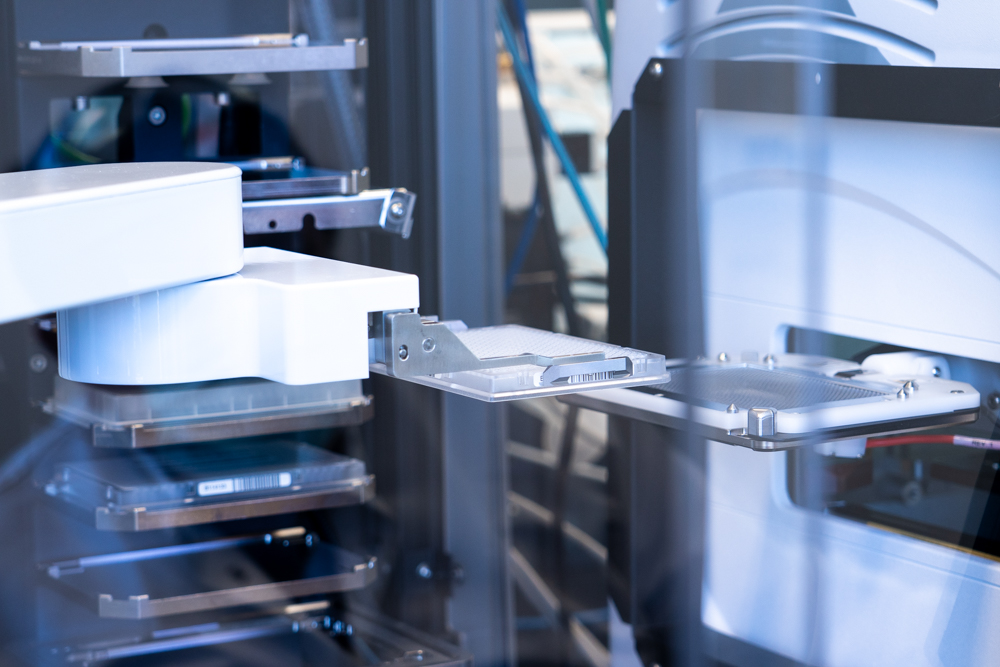
At the center of the facility is an integrated BSL-2 automated workcell supporting arrayed lentivirus preparation and titration, cell maintenance, transduction, and high-throughput screening.
Background Shape
Background Shape

Accomplishments To Date

  • January 2021: Built and validated core suite of CRISPRi/a cell lines
  • March 2021: Computational pooled screen analysis pipeline deployed
  • July 2021: First in-house FACS-based screen completed
  • August 2021: Arrayed Screening platform build completed
  • August 2021: Generation of transferable genome-wide CRISPRi library
  • October 2021: First single cell functional genomics screen completed
Background ShapeBackground Shape

Our Roadmap

PAST

May 2019:
Collaboration agreement signed

October 2019:
Inaugural LGR symposium

April 2020:
First wave of university-funded projects to support Covid research

July 2020:
First collaborative project initiated

October 2020:
First genome-wide screen completed

PRESENT

August 2021:
SOMETHING ABOUT AUTOMATION EQUIPMENT / THERMO SYSTEM

FUTURE

[Date]
Transferable CRISPRi library

[Date]
Computational pipeline?

[Date]
Staffing %

Our Goals

  • Build advanced CRISPR-based genome editing and functional genomics platforms that are enhanced by human genetics and computational biology
  • Discover novel drug targets with high probability of success and expand our knowledge of the human genome in various disease contexts
  • Innovate and industrialize CRISPR functional genomics to provide world-class technology solutions and research tools to UC, GSK, and the broader scientific community.
Background Shape
Background Shape
Joining forces to advance genomic research and improve drug discovery
Learn more about who we are, what we do, and why we do it.

The Start

The LGR is the brainchild of Professor Jennifer Doudna, UCB, a co-inventor of CRISPR technology and HHMI Investigator, 2020 Nobel Prize Laureate in Chemistry; Professor Jonathan Weissman, UCSF, a pioneer of CRISPR screening technology and HHMI Investigator; and Dr. Hal Barron, Former Chief Scientific Officer and President, R&D, GSK. The five-year collaboration to establish a state-of-the-art laboratory for CRISPR technologies was announced in June 2019. Since our founding, we have set in motion several collaborative projects between UC & GSK across different disease areas as well as funded multiple independent university research projects at both UCSF and UC Berkeley.
See our projects
Background ShapeBackground Shape

Our Founders

Jennifer Doudna
CRISPR Co-Inventor, 2020 Nobel Prize Laureate in Chemistry, UC Berkeley Professor of Biochemistry, Biophysics & Structural biology, HHMI Investigator
Read Bio
Jeremy Reiter
UCSF physician-scientist and HHMI Investigator whose research focuses on cilia biology and its implications in human disease.
Read Bio
Fyodor Urnov
Gene editing pioneer at UC Berkeley & the Innovative Genomics Institute (IGI), advancing CRISPR technologies for therapeutic applications.
Read Bio
Background Shape

Partners

UCSF Logo
UC San Francisco (UCSF) is a leading university dedicated to promoting health worldwide through advanced biomedical research, graduate-level education in the life sciences and health professions, and excellence in patient care.
GSK Logo
GSK is a science-led global healthcare company with a special purpose: to help people do more, feel better, live longer. At GSK, we’re bringing together great science, new tech, and outstanding people with the goal of doubling our development success rate to make a difference in more patients’ lives.
UC Berkeley Logo
UCB is the world’s premier public university with a mission to excel in teaching, research and public service. This mission has led to the university's distinguished record of world-class scholarship, innovation, concern for the betterment of our world, and top rankings for its schools and departments.

What’s Next Starts With the Right Question.

Tell us what you are working on. We can help identify the expertise, technologies, and approach that best fit your research.